
Short answer: a check valve stops gas from flowing backward up a hose. A flashback arrestor stops a flame from travelling back through your system. They perform different safety functions, and a check valve is not a substitute for a flashback arrestor. For oxy-fuel systems, both functions need to be addressed on both hoses.
Ask four people in your shop what the brass fitting between the hose and the torch actually does, and you may get four different answers:
- “It stops flashbacks.”
- “It stops backflow.”
- “They’re the same thing — just two names for the same device.”
- “The torch came with it, so it must be enough.”
Only one of those answers is completely accurate, and the distinction matters, because it is a safety issue.
Check valve vs flashback arrestor at a glance
| Reverse flow check valve | Flashback arrestor | |
|---|---|---|
| What it stops | Prevents reverse gas flow that could allow oxygen and fuel gas to mix | Flame travelling back through the gas system |
| How it works | Uses a spring, diaphragm or similar one-way mechanism to permit flow in only one direction | Uses a flame-arresting element to quench a flame and prevent it from travelling upstream |
| Stops a flame? | No | Yes |
| Prevents gas mixing? | Yes, that is its primary purpose | Yes — only if it also holds a non return valve |
| Device standard | ISO 5175-2 | ISO 5175-1 |
The important distinction
A check valve is essentially a one-way gate. It helps prevent oxygen and fuel gas from flowing backward and mixing in the hose or upstream equipment.
A flashback arrestor provides a different level of protection. It is designed to stop a flame from continuing upstream through the gas system. Depending on its design, it may also incorporate a non-return valve and other safety functions.
That distinction is important because preventing reverse gas flow is not the same as stopping a flame.
Many modern torch fittings and gas-safety devices combine multiple functions into a single housing. Others do not.
The fact that a device is installed between the hose and torch does not, by itself, tell you whether it is a check valve, a flashback arrestor, or a combination device.
The only reliable way to know is to identify the device and verify the manufacturer’s specifications.
For oxy-fuel cutting and welding equipment, the question should not simply be: “Do I have a safety fitting?”
The better question is: “What safety functions does this fitting actually provide?”
Because when it comes to torch safety, backflow protection and flashback protection are not the same job — and you should know which one your equipment provides.
What does a check valve do?
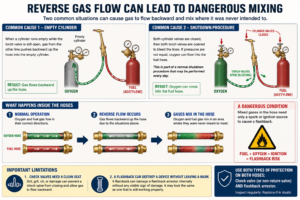
Gas flowing backward is not an unusual event. WorkSafeBC’s guideline for Section 12.120 identifies two common situations that can cause reverse gas flow. The first occurs when a cylinder runs empty while the torch valve remains open, allowing gas from the other line to push backward through the hose. The second can occur during shutdown: both cylinder valves are closed, then both torch valves are opened to bleed the lines. If the pressures are unequal, oxygen can flow into the fuel-gas hose.
Read that second example again. It is part of a normal shutdown procedure that your crew may perform every day. If your shop disagrees about the correct sequence for shutting down a torch, we cover that in our post on how to shut off an oxy-acetylene torch safely.
Once oxygen and fuel gas mix in a hose where they were never intended to meet, you have created the conditions for a flashback. All it takes is an ignition source.
Two important limitations to keep in mind. First, a check valve only works if it seals properly. Dirt, grit, oil, or damage can prevent the valve from seating and allow gas to pass when it should not. Second, a flashback can damage a safety device internally without leaving any visible sign of damage. From the outside, a damaged device may look exactly like one that is still functioning properly.
What does a flashback arrestor do?
A flashback arrestor is designed to stop a flame from travelling backward through the gas system. That is a different job from a check valve, which prevents reverse gas flow.
Inside a flashback arrestor is a flame-arresting element, commonly made from sintered metal. When a flame reaches the element, heat is rapidly absorbed from the flame front, reducing its temperature below the point needed to sustain combustion. The flame is extinguished before it can travel farther upstream toward the hoses, regulators and cylinders.
Many industrial flashback arrestors also incorporate a non-return valve, and some include additional safety features such as a thermal or pressure-activated shut-off. That means a single device can provide both reverse-flow protection and flashback protection — but you should never assume it does. Check the manufacturer’s specifications for the actual device.
The keyword is arrestor. Its purpose is not to prevent a flashback from starting. Its purpose is to arrest the flame and prevent it from travelling beyond the device.
A flashback arrestor may be damaged internally during a serious flashback, even when there is little or no visible external damage. Follow the manufacturer’s instructions regarding inspection, testing and replacement after a flashback or other damaging event.
One important trade-off
The flame-arresting element is designed to restrict the passage of a flame, but it also introduces some resistance to gas flow. If an arrestor is undersized for a high-flow heating tip, the resulting pressure drop can affect performance.
For heavy heating applications, the solution is not to remove the protection. Instead, use a properly sized, high-flow flashback arrestor that is rated for the required gas flow and application.
Backfire, sustained backfire and flashback are three different things
These three terms are often used interchangeably, but they describe different events.
Backfire
A backfire is usually heard as a sharp pop. The flame goes out or may relight at the tip.
Possible causes include incorrect gas pressure, an overheated tip, the tip being held too close to the work, or a dirty or partially blocked tip.
A single backfire may not develop into a flashback, but it should not simply be ignored. Repeated backfires are a sign that something needs attention.
Sustained backfire
A sustained backfire produces a continuous hiss, squeal or sharp flame sound. The flame is burning inside the torch or mixing area rather than only at the tip.
This is a more serious condition. Shut the torch down and investigate the cause before returning it to service.
Flashback
A flashback occurs when the flame travels backward through the torch and into the gas-mixing system and potentially into the hoses.
This is the event that flashback arrestors are specifically designed to stop.
A flashback can damage internal components and, in severe cases, allow combustion to travel farther into the gas system. That is why properly selected and maintained flashback protection is so important.
If a crew reports that a torch has “popped” several times and then returned to normal operation, log the event and investigate it. Repeated backfires are usually a symptom of an underlying problem rather than something to simply accept as normal.
What do the rules actually say?
Canada
Section 12.120 of the BC OHS Regulation specifically addresses both reverse gas flow and flashback protection. The requirements distinguish between the two safety functions rather than treating them as the same thing.
That distinction is important: a simple check valve provides reverse-flow protection, but it does not provide the flame-arresting function of a flashback arrestor.
Other Canadian jurisdictions may address the issue through a combination of occupational health and safety requirements, applicable standards such as CSA W117.2, and the manufacturer’s installation and maintenance instructions.
The practical lesson is straightforward: identify what protection the device actually provides and make sure the equipment configuration meets the requirements applicable to your workplace.
United States
The U.S. requirements can be more dependent on the type of installation and the applicable standard. OSHA contains requirements addressing backflow and flashback protection in oxy-fuel systems, while standards such as ANSI Z49.1 and applicable NFPA requirements may also apply.
For portable oxy-fuel equipment, the applicable requirements can depend on the equipment configuration, the fuel being used and the manufacturer’s instructions.
That is why relying on a single fitting or assuming that “the torch came with it” is not an adequate way to determine whether the system is properly protected.
Europe and the UK
European standards distinguish between devices that incorporate a flame-arresting function and devices that do not. ISO 5175-1 and ISO 5175-2 address different types of gas safety devices used with welding, cutting and allied processes.
If you are working with European equipment, check the marking on the device and verify the current applicable standard rather than relying solely on an older marking.
How to tell what is on your torch
Do this at the bench before your next hot-work job.
- Read the fitting. Combination devices may identify the functions they provide. Some European devices also display the applicable ISO standard. If all you can identify is a flow-direction arrow, don’t assume the device is a flashback arrestor. Check the manufacturer’s part number and specifications.
- Count the devices. Check each hose on every torch setup, including spare equipment.
- Check the flow direction. The arrow should correspond with the manufacturer’s specified direction of gas flow.
- Match the device to the gas. Oxygen-side devices must be rated for oxygen. Fuel-gas devices must be suitable for the specific fuel being used. Acetylene, propane and propylene applications are not automatically interchangeable.
- Ask two questions. When was the device last inspected or replaced? Has the torch or system ever experienced a flashback? If nobody knows, treat the history as unknown, not as evidence that the device is fine.
- Check the flow rating against the largest tip. This is particularly important for heating applications, where an undersized arrestor can restrict gas flow and affect flame performance.
While you are checking the equipment, inspect and leak-test the connections as well. Our gas leak test procedure covers the process.
What neither device protects you from
Check valves and flashback arrestors are important safety devices, but they are last-line protection. They react to conditions that have already developed within the gas system.
Neither device addresses one of the most fundamental hazards of torch work: gas continuing to flow when nobody is holding the torch.
A torch can be set down while lit. It can be dropped from a platform with the valves open. A leaking tip can allow gas to accumulate in a confined or poorly ventilated area while the operator is somewhere else.
That is a different hazard from flashback. It is a control problem at the operator’s hand, not a flame problem inside a fitting.
That is why the Safe-T Torch™ uses a trigger-release design. When the operator releases the trigger, the gas flow is shut off at the torch.
It does not replace check valves or flashback arrestors. It addresses a different hazard with a different engineering control.
Common questions
Do I need both a check valve and a flashback arrestor?
The answer depends on the specific device and the requirements applicable to your equipment and jurisdiction. A combination flashback arrestor may incorporate both functions in one device.
The important point is to verify that both reverse-flow protection and flashback protection are provided where required.
Should flashback arrestors go at the torch or the regulator?
That depends on the manufacturer’s instructions, the equipment configuration, local regulations and the application.
Torch-mounted devices can provide protection closer to the torch and protect more of the downstream system. High-flow devices at the regulator may be appropriate for heavy heating applications.
Always follow the manufacturer’s installation requirements and local regulations.
How do I know if my check valve still works?
You often cannot determine its condition simply by looking at it.
Dirt, oil, wear or damage can prevent a check valve from sealing properly. A flashback can also damage the internal components of a safety device without leaving obvious external evidence.
Follow the manufacturer’s inspection and testing procedure, including any recommended replacement schedule.
A note about regulations and standards
This article discusses occupational safety requirements and industry practices to help explain the difference between reverse-flow protection and flashback protection.
This article is provided for general safety and informational purposes only and is not intended to constitute legal, engineering or regulatory advice. Occupational health and safety requirements may vary by jurisdiction, equipment and application and may change over time. Always consult the current applicable regulations, standards and equipment manufacturer’s instructions before installing, modifying or operating an oxy-fuel system.
Your turn
Go look at one torch setup. Just one.
Look at the fitting between the hose and the torch handle. Read the markings and identify the part number.
Then ask yourself: does this device prevent reverse gas flow, arrest a flame, or do both?
If you cannot determine the answer from the information available, don’t guess. Find the manufacturer’s specifications.
Because when it comes to torch safety, knowing that a fitting is there is not the same as knowing what protection it actually provides.
Tell us what you found on your rig.
Send a photo of the fitting or a question about your setup, and we will tell you what you are looking at.
If you want a dollar figure instead of a toolbox argument, our Accident Cost Analysis calculator puts a number on a single torch incident.
